
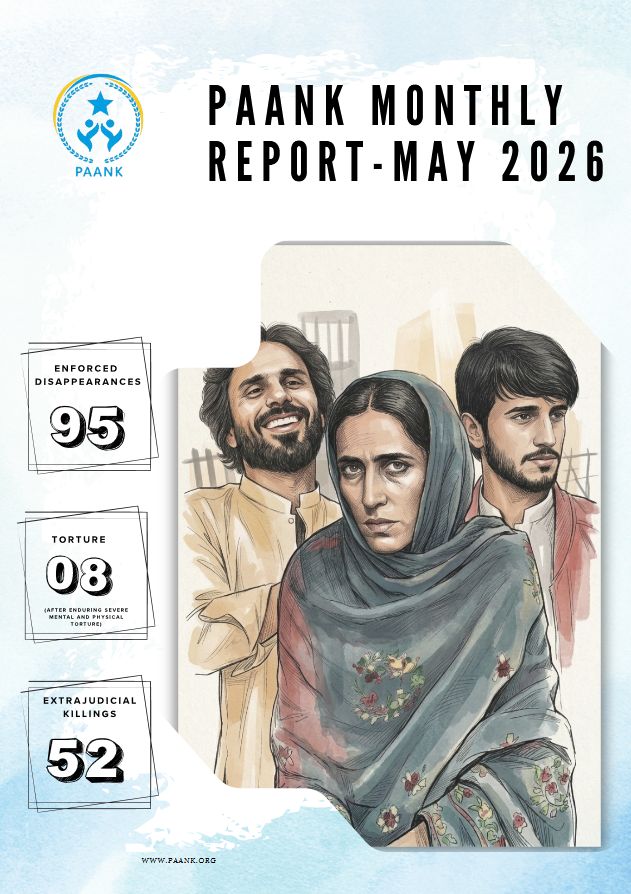
This report documents the alarming human rights abuses occurring in Balochistan, with a particular focus on enforced disappearances and extrajudicial killings. The cases recorded during May 2026 reveal a deeply concerning pattern of state repression, arbitrary detentions, physical and psychological torture, and unlawful executions carried out by Pakistani security forces. These abuses underscore a continuing climate of impunity and fear across Balochistan.
A total of 95 cases of enforced disappearances were documented, reflecting widespread and systematic targeting of civilians. Additionally, 22 victims were released after enduring severe mental and physical torture, further illustrating the use of coercive interrogation methods.
During this month, 52 confirmed cases of extrajudicial killings were recorded, highlighting the lethal consequences of unchecked state power. These findings reflect the deteriorating human rights situation in Balochistan and indicate an urgent need for independent investigations, accountability mechanisms, and international monitoring to protect vulnerable communities.
Statistics of Enforced Disappearances – May 2026
The following districts reported cases of enforced disappearances and illegal detentions during May 2026:
Quetta: 23
Kech (including Turbat, Mand, Hoshab, etc.): 13
Kohlu (Chamalang Tehsil): 13
Dera Bugti (Sui): 11
Nushki: 7
Awaran (including Jhao, Geshkore): 8
Panjgur (including Paroom): 5
Surab (Zehri): 2
Lasbela (Windar / Hub Chowki): 4
Barkhan: 2
Karachi: 2
Chagai: 1
Gwadar (Pasni / Jiwani): 3
Washuk (Naag): 1
Harnai: 1
Not specified / Unknown: 2
Documented cases of Extrajudicial Killings
A total of 52 individuals were extrajudicially killed across Balochistan during May 2026. These incidents reflect an alarming escalation in staged encounters, targeted assassinations, and custody killings, further highlighting the severe lack of legal accountability and due process.
Extrajudicial Killings
Abdullah Baloch
On May 2, 2026, 25-year-old driver Abdullah Baloch, son of Peer Muhammad, was extrajudicially killed after a short-term enforced disappearance. Frontier Corps (FC) personnel raided his home at around 4:30 AM in the Dambani Syahgesi area of Zamuran, Kech district, assaulted his family, and forcibly abducted him along with his father, dumping his dead body near an FC camp just five hours later.
Khuda Peer Muhammad Baloch
On May 2, 2026, 55-year-old farmer and local elder Khuda Peer Muhammad Baloch, son of Haji Abdullah Rasheed, was extrajudicially killed by the Frontier Corps (FC) in the Zamuran area of Kech district. After speaking out against the burning and destruction of civilian homes, FC personnel raided his house in Dambani Syahgesi, assaulted his family, and forcibly disappeared him along with his son Abdullah, dumping his lifeless body near the FC camp five hours later.
Ajmal Baloch
On May 3, 2026, young laborer Ajmal Baloch, son of Yaseen and a resident of Nasirabad, Turbat, was extrajudicially killed after enduring 256 days of enforced disappearance. Abducted from Gwadar city on August 21, 2025, by personnel of the Frontier Corps and military agencies, the sole provider for his family was held in illegal custody without trial until his bullet-riddled body was recovered in the Nalent area of Pasni, Gwadar district.
Saeed Ahmed / Saeed Muhammad
On May 3, 2026, 49-year-old shopkeeper Saeed Ahmed (Saeed Muhammad), son of Shahoo Baloch, was extrajudicially killed in state custody after 145 days of enforced disappearance. Abducted during a late-night raid from his home in Panwan, Jiwani, on December 9, 2025, by Frontier Corps personnel, his bullet-riddled body was dumped and recovered in the Nalent / Naleent Daro Guard area of Pasni, Gwadar district.
Buhran Uddin
On May 12, 2026, 19-year-old Zamyad driver Buhran Uddin, son of Muhammad Naeem and originally from Zamuran, was extrajudicially killed following 6 months and 14 days of enforced disappearance. Forcibly abducted from his home in Bug Meeri, Turbat, on October 28, 2025, by state-backed death squads and Military Intelligence (MI), his severely tortured body was dumped in the Kech Kour area of Turbat, Kech district.
Jan Muhammad
On May 13, 2026, 18-year-old student Jan Muhammad, son of Qadir Bakhsh and a resident of Gomazi, Tump, was extrajudicially killed after 3 months and 21 days of enforced disappearance. Forcibly taken from Jusak, Turbat, on January 24, 2026, by a state-backed death squad, the 8th- class student’s tortured and bullet-riddled body was dumped in the Banuk-e-Chadai area of Kech district, where his family identified him via his student ID card.
Zaheer Niaz & Mehraj Niaz (Collective Punishment Case)
On May 13, 2026, the Pakistan Army bulldozed the civilian homes of Master Niaz Baloch and Master Huzoor Bakhsh Baloch and destroyed their date palm trees in Peer Mashkai, Kallar area of Awaran district, as part of a policy of collective punishment. This act followed the earlier enforced disappearances and extrajudicial executions of Master Niaz Baloch’s two sons, Zaheer Niaz and Mehraj Niaz, who were forcibly disappeared on February 28, 2025, before Mehraj’s mutilated body was dumped on March 3, 2025, and Zaheer was killed on March 26, 2025.
Professor Ghamkhwar Hayat Baloch (Muhammad Khan)
On May 16, 2026, renowned Brahui-language poet, author of fifteen books, and Assistant Professor at Degree College Noshki, Professor Ghamkhwar Hayat Baloch (Muhammad Khan), son of local political activist Abdul Majeed Sasoli, was targeted and extrajudicially killed by state- backed death squads in the Killi Mengal area of Noshki district.
Muhsin
On May 19, 2026, 21-year-old driver Muhsin, son of Muslim and a resident of Suleman Bazar, Paroom, was extrajudicially killed in state custody after enduring 66 days of enforced disappearance. Forcibly abducted on March 16, 2026, from the Jeerak crossing point in Panjgur by Frontier Corps personnel, the main breadwinner for his family was held in secret detention until his dead body was recovered from Kallag Koor, Paroom, Panjgur district.
Sheerdil Baloch
On May 20, 2026, elderly farmer Sheerdil Baloch, son of Qadir Bakhsh, was shot and killed by Frontier Corps (FC) personnel in his own farmland in Drachko Dasht, Turbat, Kech district, while peacefully working to earn a livelihood for his family.
Mehran Baloch
On May 21, 2026, 27-year-old shopkeeper Mehran Baloch, son of Muhammad Sharif, was targeted and extrajudicially killed in broad daylight by state backed death squads in the Surap Bazaar area of Buleda, Kech district, while leaving for his shop to earn a living for his family.
Shah Hussain
On May 24, 2026, 26-year-old police constable Shah Hussain, son of Shafi Jan, was targeted and extrajudicially killed by state-backed death squads in broad daylight in the Tasp area of Panjgur district.
Impacts of Enforced Disappearances and Extrajudicial Killings
Enforced disappearances and extrajudicial killings in Balochistan generate severe, multi-faceted
consequences that ripple across social, economic, psychological, and institutional structures.
- Devastating Socio-Economic Impact
Loss of Family Breadwinners: A high percentage of forcibly disappeared and extrajudicially killed individuals are young men, students, drivers, shopkeepers, and primary earners. Their absence plunges entire extended families into sudden severe poverty, hunger, and debt.
Economic Paralysis & Displacement: Families often exhaust their entire savings, sell homes, or abandon livelihoods to travel across cities—from Turbat and Quetta to Karachi and Islamabad— to attend court hearings, set up protest camps, or identify bodies.
Impact on Women and Children: Thousands of women are left as “half-widows”—a status where they cannot claim inheritance, state aid, or remarry because their husbands are neither declared dead nor confirmed alive. Children are frequently forced to abandon education to enter the labor force early. - Deep Psychological Trauma & “Ambiguous Loss”
The Torture of Uncertainty: Mental health professionals and human rights advocates note that enforced disappearance inflicts a distinct form of psychological torture known as ambiguous loss. Families live in perpetual distress—stuck between grief and hope—never knowing if their loved one is being tortured, starved, or already dead.
Intergenerational Fear: The continuous recovery of mutilated, torture-marked bodies dumped on roadsides creates pervasive collective trauma, anxiety, and severe PTSD across local communities. - Collective Harassment and Reprisals against Families
Targeting of Protesters: Families who publicly demand justice, set up hunger strike camps, or organize marches face ongoing state harassment, surveillance, threats, and bogus criminal charges.
Direct Reprisals: As highlighted in recent Paank reports, relatives speaking out face direct violence—such as the targeted killing of 70-year-old retired teacher Inayat Ullah in Khuzdar, targeted following public appeals made by his activist daughter, Asma Jattak. - Systemic Breakdown & Erosion of the Rule of Law
Judicial Impunity: The routine failure of civilian courts and official missing persons commissions to hold security forces (FC, CTD, intelligence agencies) accountable erodes public trust in state institutions and the legal system. Normalizing Staged Encounters: Presenting previously disappeared individuals as “terrorists killed in encounters” institutionalizes state extrajudicial violence and deprives victims of any judicial process or posthumous dignity. - Escalation of Conflict and Mass Mobilization
Fueling Cycles of Alienation: Instead of subduing dissent, heavy-handed state repression alienated local populations, deepening grievances and driving community resistance. Rise of Women-Led Civil Movements: The severe impact on families has triggered unprecedented political mobilization, transforming affected women into the primary leaders of non-violent anti-enforced disappearance movements across Pakistan.
Conclusion and Appeal to the International Community
The cases documented in this report reveal a worsening human rights crisis in Balochistan. The continued use of enforced disappearances, torture, extrajudicial killings, and collective punishment has created a climate of fear and insecurity across the region. The recording of 95 enforced disappearances, 15 releases following reported torture, and 52 extrajudicial killings during May 2026 demonstrates that these violations are not isolated incidents but part of a continuing pattern affecting ordinary civilians, including students, labourers, women, children, and elderly people.
Particular concern must be given to the increasing targeting of Baloch women and the use of collective punishment against the families of political activists, journalists, and human rights defenders. Reports of enforced disappearances, intimidation, forced confessions, home raids, and reprisals against family members represent serious violations of fundamental human rights and deepen the suffering of already affected communities.
PAANK urges the United Nations, the European Union, democratic governments, and international human rights organisations to take immediate notice of the situation in Balochistan. Independent investigations must be conducted into allegations of enforced disappearances, torture, extrajudicial killings, and attacks on civilians, and those responsible must be held accountable.
The families of the disappeared deserve truth and justice. Continued international silence will only encourage further abuses and strengthen the culture of impunity. Meaningful international attention, sustained monitoring, and concrete action are urgently needed to protect the rights, dignity, and security of the Baloch people
About Us
Paank is the human rights department of the Baloch National Movement (BNM), which aims to raise awareness and promote human rights in Balochistan. BNM is a political organization dedicated to the rights and freedoms of the Baloch people in Balochistan. Paank focuses on the protection and promotion of human rights in Balochistan by conducting investigations, documenting human rights abuses, and advocating fornchange. Its monthly report on the human rights situation in Balochistan provides up-to-date information on the state of human rights in the region and highlights areas where improvement is needed. These reports serve as a valuable resource for those concerned with human rights in Balochistan and provide a platform for BNM to voice its concerns and advocate for change.One of the key areas of focus for Paank is the issue of enforced disappearances in Balochistan. This is a serious concern in the region and has been widely reported by human rights organizations.
Paank works to document cases of enforced disappearances and bring attention to this issue in the hopes of bringing an end to this human rights violation. The website will regularly update information on enforced disappearances, including the number of cases, the names of those who have disappeared, and the efforts being made to secure their release.
Paank is also active in organizing events and activities that promote human rights in Balochistan. These events range from peaceful protests to public awareness campaigns and educational seminars. Paank’s events provide a platform for the Baloch people to voice their concerns and demand change. The website will share updates on Paank’s events and activities, allowing supporters to stay informed and get involved.
Paank is a vital part of BNM’s efforts to promote human rights in Balochistan. Its monthly reports and updates on enforced disappearances provide valuable information and insight into the human rights situation in the region. Its events and activities help to raise awareness and promote change. The website provides a platform for Paank to share its work and engage with supporters, making it an essential resource for anyone concerned with human rights in Balochistan.
Baloch National Movement (BNM) is an organization struggling for the independence of Balochistan from Pakistan. The human rights department of BNM, known as Paank, focuses on raising awareness about the human rights situation in Balochistan. Paank’s mission is to advocate on all forums to bring global attention to the atrocities committed in Balochistan and to work towards a better future for the Baloch people. Paank’s team is dedicated to creating a brighter future for the Baloch people. Through their tireless efforts, Paank works to bring justice to the victims of human rights violations in Balochistan and to hold those responsible accountable for their actions.