
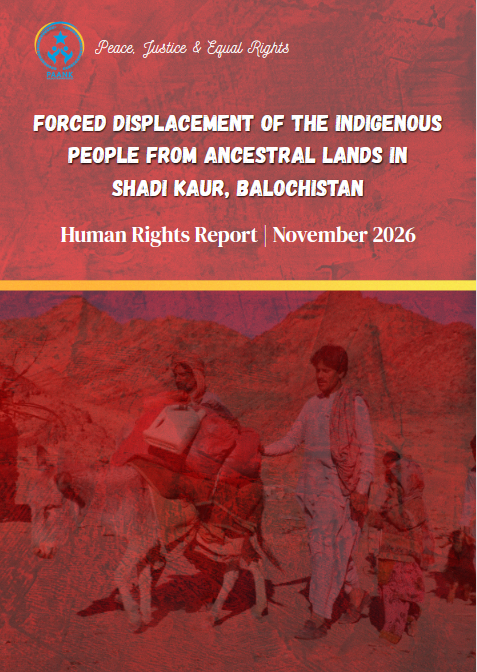
Forced Displacement and Indigenous Land Rights
Approximately 5,000 indigenous Baloch inhabitants, representing almost the entire population of Shadi Kaur in Pasni tehsil, Gwadar district, were forcibly displaced from their ancestral lands on 11–12 July 2026 following military operations, enforced disappearances, mass detentions, restrictions on essential supplies and eviction orders issued by the Pakistan Army.
For generations, the Baloch people of Shadi Kaur have inhabited and cultivated these lands, preserving their history, traditions, agricultural livelihoods and collective identity. Their ancestral territory represents more than a place of residence; it constitutes an integral part of the Baloch nation’s cultural heritage, historical continuity and intergenerational existence. On 9–10 July, Pakistani military personnel ordered inhabitants to vacate their homes, warning that their houses would be burned if they remained.
Military Operations and Human Rights Violations
On 5 May 2026, Pakistani forces and military intelligence personnel detained between 85 and 100 men, subjected them to beatings, forced them to lie under the sun and pushed stones into the mouths of those who cried out. Approximately 40 detainees were transferred to an army camp near Shadi Kaur Dam and forcibly disappeared. Several remain missing.
Between 5 and 8 May, a three-day military blockade restricted movement across Shadi Kaur, Zareen Kaur, Tarati, Goristani and Kabadi. Eight people, including women and children returning from medical treatment, were detained for two days. Throughout May and June, food and household supplies were turned back at the Gabdi military checkpoint.
Sardil, son of Sher Khan, forcibly disappeared by military intelligence personnel on 22 November 2025, was killed, and his mutilated body was recovered near Pasni on 30 May 2026.
Humanitarian and Cultural Consequences
Displaced Baloch families fled to Pasni, Ormara, Turbat and surrounding towns, with many living in tents. Approximately 10,000 acres of agricultural land were abandoned, disrupting farming, food security, education, healthcare and traditional livelihoods.
The displacement threatens the Baloch people’s ancestral attachment to land and the transmission of cultural and historical identity across generations.
Wider Pattern of Repression
Paank, the Human Rights Department of the Baloch National Movement, documented 1,355 enforced disappearances and 225 extrajudicial killings in 2025, followed by 556 enforced disappearances and 227 extrajudicial or custodial killings during January–June 2026.
Paank separately documented an evacuation order affecting approximately 30,000 people in Shoor Paarod, Kalat, in October 2026.
International Legal Obligations and Recommendations
These reported violations raise serious concerns under the ICCPR, ICESCR, Convention against Torture, UN Guiding Principles on Internal Displacement and Article 10 of the UN Declaration on the Rights of Indigenous Peoples.
Urgent measures are required to halt forced displacement, disclose the whereabouts of disappeared persons, ensure independent investigations, provide humanitarian assistance and guarantee the safe, voluntary and dignified return of the indigenous Baloch population to their ancestral lands.