
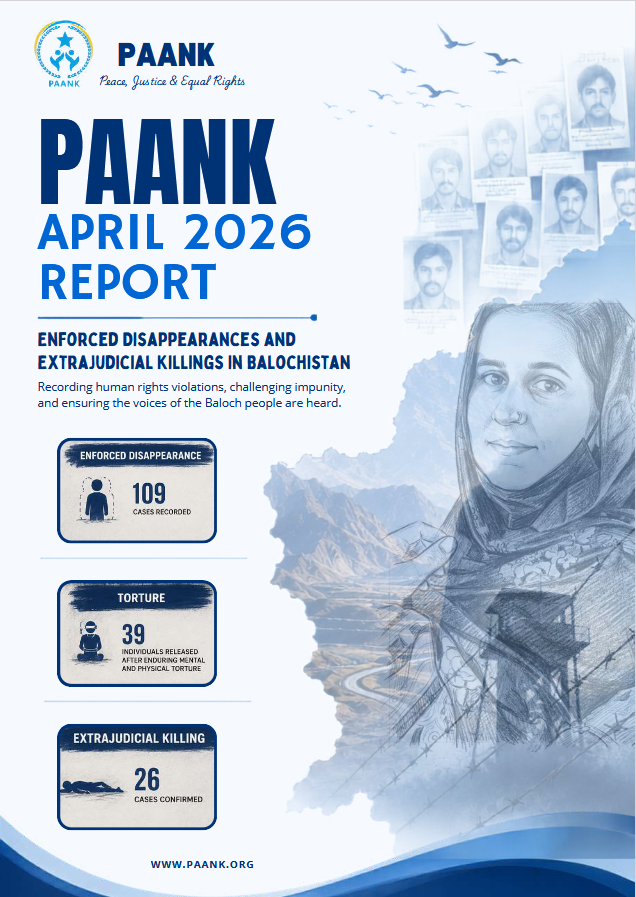
This report documents the alarming human rights violations taking place in Balochistan with a particular focus on enforced disappearances and
extrajudicial killings. The cases recorded during April 2026 reveal a deeply troubling pattern of arbitrary detention, enforced disappearance, physical and psychological torture, and unlawful killings allegedly carried out by Pakistani security forces and state-backed armed groups. These violations continue to create a climate of fear, insecurity, and impunity across Balochistan.
During April 2026, Balochistan experienced a sustained rise in human rights abuses. In addition, cases linked to the broader Baloch conflict were also
reported from Karachi in Sindh and Dera Ghazi Khan in Punjab. The geographic spread of these incidents highlights the continuing vulnerability of Baloch individuals both within and beyond Balochistan.
A total of 109 cases of enforced disappearances were documented during the month, reflecting the widespread and systematic targeting of civilians. Of
these, 39 individuals were later released after periods of unlawful detention, during which they reportedly endured severe physical and psychological
torture. Their accounts provide further evidence of the use of coercion, mistreatment, and intimidation in custody.
The report also documents 26 confirmed cases of extrajudicial killings. Many of the victims had reportedly been subjected to enforced disappearance before their bodies were later recovered, raising serious concerns about unlawful killings and the denial of due process. These cases illustrate the deadly consequences of unchecked state power and the absence of accountability. The findings presented in this report point to a worsening human rights situation in Balochistan. They underscore the urgent need for independent and impartial investigations, effective accountability mechanisms, and sustained international attention to protect the fundamental rights, safety, and dignity of the Baloch people.
Statistics of Enforced Disappearances — April 2026
The following districts reported cases of enforced disappearances and illegal
detentions during April 2026:
- Kech: 22
- Panjgur: 17
- Karachi: 15
- Quetta: 12
- Dera Bugti: 10
- Gwadar: 9
- Mastung: 7
- Khuzdar: 4
- Kharan : 4
- Surab: 2
- Barkhan : 2
- Nushki: 2
- Dera Gazi khan: 2
- Jhal Magsi : 1
1.Cases of Enforced Disappearances
A total of 109 individuals were forcibly disappeared across Balochistan. These incidents reflect ongoing patterns of arbitrary arrest, incommunicado detention, and denial of due process.
Notably:
39 individuals were later released after enduring mental and physical torture.
2.Extrajudicial Killings
The extrajudicial killings by Pakistani forces in Balochistan continue unabated. The Pakistani military is reportedly detaining and killing individuals without due process for undisclosed reasons. In the month of April 26 People were extrajudicially killed.
Summary of All Three Categories — April 2026
- A total of 109 cases of enforced disappearances were recorded.
- 39 individuals were later released.
- 26 cases of extrajudicial killings were confirmed.
Anatomy of an Abduction in Balochistan
The cases documented during April 2026 reveal a recurring pattern in enforced disappearances and extrajudicial killings across Balochistan. While each victim’s story is unique, many incidents follow a similar sequence, highlighting a systematic process that has created fear and uncertainty throughout the region.
- Targeting and Surveillance
Victims are often ordinary civilians, including students, labourers, drivers, shepherds, government employees, shopkeepers, and tailors. Many are taken
from their homes, workplaces, markets, checkpoints, or while travelling. Families frequently report that victims appeared to have been monitored before their abduction.
- Arrest Without Warrant or Due Process
The abductions are commonly carried out by personnel identified by witnesses as members of the Frontier Corps (FC), intelligence agencies, police units, or armed groups described by local residents as state-backed death squads.
In most documented cases:
- No arrest warrant is presented.
- No formal charges are disclosed.
- Family members are not informed of the reason for detention.
- The detainee is taken to an undisclosed location.
Abductions often occur in broad daylight and in front of family members, neighbours, or other witnesses.
- Incommunicado Detention
Following the abduction, victims effectively disappear from the protection of the law.
Families typically face:
- No information regarding the victim’s whereabouts.
- Denial of custody by authorities.
- Lack of access to legal representation.
- Inability to communicate with the detainee.
This period can last from days to several years. Families are often left searching hospitals, police stations, courts, prisons, and military camps without receiving answers.
- Torture and Ill-Treatment
The experiences of those released indicate that detainees are frequently subjected to severe physical and psychological abuse during detention. According to documented cases, released individuals reported:
- Physical torture.
- Threats and intimidation.
- Psychological pressure.
- Prolonged interrogation.
- Inhumane detention conditions.
During April 2026 alone, 39 individuals were released after periods of enforced disappearance, many reportedly showing signs of mental and physical trauma.
- Two Possible Outcomes
For many victims, enforced disappearance ends in one of two ways.
Release After Torture
Some detainees are eventually released without charge. Many return home traumatised, physically weakened, and reluctant to speak openly about their
experiences due to fear of reprisals.
Extrajudicial Killing
Others never return alive. In numerous documented cases, victims who had previously been forcibly disappeared were later found dead. Their bodies were often discovered in remote areas, roadsides, or deserted locations.
Common features include:
- Bullet wounds.
- Signs of torture.
- Bodies abandoned far from the place of abduction.
- No independent investigation into the circumstances of death.
Cases documented during April 2026, including those of Sabzal Baloch, Qamber Baloch, Sadiq Noor, Muslim Dad, Marwan Baloch, Hatim Baloch, Shahram, and Zulfiqar Baloch, reflect this pattern, where individuals were allegedly taken into custody before later being found dead.
- Impunity and Fear
A defining feature of these cases is the absence of accountability. Families rarely receive official explanations regarding the fate of their loved ones. Investigations are uncommon, prosecutions are virtually non-existent, and those responsible are seldom held accountable.This climate of impunity has created widespread fear throughout Balochistan. Families live with the constant risk that a relative may be taken without warning, held in secret detention, and never return.
April 2026 at a Glance
- 109 cases of enforced disappearances documented.
- 39 individuals released after periods of detention and reported torture.
- 26 cases of extrajudicial killings confirmed.
These figures demonstrate that enforced disappearance in Balochistan is not an isolated occurrence but part of a broader pattern of human rights violations that continues to affect communities across the region.
Extrajudicial Execution and the “Kill and Dump” Policy
Extrajudicial Killings: A Continuing Cycle of Violence and Impunity
The cases documented during April 2026 indicate a continuing pattern in which enforced disappearances are followed by extrajudicial killings. Many victims were reportedly taken into custody by security forces or state-backed armed groups and subsequently disappeared for days, months, or even years before their bodies were recovered.
Several of the victims, including Qamber Baloch, Sadiq Noor, Muslim Dad, Marwan Baloch, Hatim Baloch, Shahram, and Zulfiqar Baloch, were allegedly detained before their bullet-riddled bodies were later found in different parts of Balochistan. The repeated appearance of bodies bearing gunshot wounds, often abandoned in remote locations, raises serious concerns about the use of unlawful lethal force and the denial of basic legal protections guaranteed under both domestic and international law.
These incidents suggest a pattern in which individuals are removed from the protection of the law and subsequently killed without judicial process or accountability.
The victims documented during April 2026 came from diverse backgrounds, including students, labourers, drivers, shepherds, government employees, and skilled workers, indicating that the violence was not limited to any single group.
The reported killings of young students such as Chakar Baloch, Marwan Baloch, and Hatim Baloch, alongside the deaths of civilians including tailor Israr Baloch and labourer Muhammad Khalid, highlight the broad impact of these violations on Baloch society.
Particularly alarming was the reported attack on a nomadic Marri family in Barkhan district, which resulted in the deaths of twelve civilians, including women and children, and left several others injured. The absence of transparent investigations, prosecutions, or official explanations in these cases contributes to a climate of impunity and deepens fear among local communities. Collectively, these incidents point to a worsening human rights situation in Balochistan and reinforce the urgent need for independent investigations and international scrutiny.
Documented Cases of Extrajudicial Killings
The following section provides detailed accounts of reported incidents, highlighting cases of extrajudicial killings, enforced disappearances, torture, and other human rights violations documented during April 2026.
1- Israr Baloch
Israr Baloch, a 25-year-old master tailor and son of Muhammad Anwer, was a resident of Qambrani Road, Killi Bangulzai, Quetta. He was reportedly detained on 25 March 2026 by personnel of the Eagle Force from Qambrani Link Road near Keachi Baig Police Station. According to reports, he later killed in custody on 1 April 2026.
2- Sabzal Baloch
Sabzal Baloch, son of Badal, was an 18-year-old resident of the Khairabad area of Turbat, Kech. He was reportedly forcibly disappeared on 25 July 2026 from the FC checkpoint in Tallar, situated between Gwadar and Turbat. His bullet- riddled body was later found dumped in the Paleri area of Gwadar on 1 April 2026.
3- heyhaq Raheem
Sheyhaq Raheem son of Raheem Bakhsh, resident of Buleda was forcibly taken by state-backed death squad in the main Bazar of Minaz, Buleda on March 31, 2026. He was extrajudicially killed and his bullet-riddled body was discovered from the Pasni link road area in Banuk-e-Chadai, Turbat on April 5, 2026.
4- Chakar Baloch
Chakar Baloch son of Barkat, an 18 year-old student was extrajudicially killed by a state-sponsored death squad. He was targeted at his shop in Mehnaz, where armed men affiliated with a state-backed death squad opened fire on him, killing him on the spot.
5- Qamber Baloch
Qamber Baloch son of Khuda Bakhsh, a young student from Solo, Buleda area of Kech district was forcibly taken from his home in By FC. On April 8, 2026 his bullet-riddled body was found in D-Baloch area of Turbat city.
6- Sadiq Noor
Sadiq Noor son of Noor Ullah, from Gilli Bahot Bazar, Buleda, was a student forcibly taken from his home in Absar, Turbat by FC on September 7, 2025. On April 10, 2026, his lifeless body was dumped in Kechkhoor, Turbat.
7- Muslim Dad
Muslim Dad son of Malang Dad, from Gilli Bahot Bazar, Buleda, Kech was a hardworking driver , forcibly disappeared from his home in Absar, Turbat, at
1.30 PM by FC and MI. in broad daylight, in front of his people, he was taken and silence was forced upon his family. For 4 months and 28 days of enforced disappearance his lifeless body was found in Kechkhoor, Turbat on April 10, 2026.
8- Muhammad Khalid
Muhammad Khalid, son of Ameer Muhammad, was an 18-year-old Labourer from Nushki district. He had travelled to Quetta with two friends to sell their motorcycle and buy furniture. During their visit, the group donated blood at a hospital in an effort to help save a woman’s life. Later that evening, near Saryab Road, they were reportedly pursued by personnel of the Eagle Squad, who allegedly opened fire without warning. According to reports, his two friends were thrown from the motorcycle, while Khalid was separated, assaulted, and shot at close range
9- Marwan Baloch
Marwan Baloch son of Hamza Baloch, an 18-year-old student and resident of Legork, Paroom area of Panjgur district was forcibly disappeared from his home by FC personnel on April 5, 2026. He was extrajudicially killed and his bullet- riddled body brought to civil hospital on April 16, 2026.
10- Hatim Baloch
Hatim Baloch son of Haji Muhammad, an 18-year-old student and resident of Legork, Paroom area of Panjgur district was forcibly disappeared from his home by FC personnel on April 5, 2026. He was extrajudicially killed and his bullet- riddled body brought to civil hospital on April 16, 2026.
11- Shahram
Shahram son of Bahran, a 38-year-old sphered and resident of Gishtagan area
of Paroom, was forcibly disappeared from Nehing area of Zamuran by the FC personnel. He was extrajudicially killed and his bullet-riddled body brought to civil hospital on April 16, 2026.
12- Zulfiqar Baloch
Zulfiqar Baloch son of Musafer, a 47-year-old shepherded and resident of Gishtagan area of Paroom, was forcibly disappeared from Nehing area of
Zamuran by the FC personnel. He was extrajudicially killed and his bullet- riddled body brought to civil hospital on April 16, 2026.
13- Ayaz Baloch
Ayaz Baloch son of Khuda Bakhsh, was a 26-year-old government school cleaner from Tasp, Panjgur was targeted-killed in Nokabad, Tasp, near his home at 9:30 PM by a death squad.
Mass Killing Civilians in Barkhan district of Balochistan
According to reports received by Paank, the incident occurred when a nomadic family belonging to the Marri tribe was passing through the area along the Naher Kot Road during seasonal migration in a Mazda vehicle. As per as local sources, the vehicle came under attack and fire from Pakistani security forces, leading to heavy civilian losses.
The individuals Killed in the incident have been identified as:
1.Ali son of Sultan (40)
2.Bebel w/o Ali (30)
3.Mir Jan son of Ali (2)
4.Balach son of Sabzo (70)
5.Soomari d/o Bhangan and wife of Balach (35)
6.Sado d/o Balach (13)
7.Hapo d/o Balach (8)
8.Mahrang d/o Balach (2)
9.Allah Bakhsh s/o Balach (6)
- Rahman s/o Balach (18)
- Naikho d/o Jamalan and wife of Rahman (17)
- Shari
The following individuals sustained injuries
- Zar Bibi wife of Balach ,aged 55
- Hazar Khan son of Balach, aged 9
- Israr d/o Balach , aged 15
Conclusion and Appeal to the International Community
The cases documented in this report reveal a worsening human rights crisis in Balochistan. The continued use of enforced disappearances, torture,
extrajudicial killings, and collective punishment has created a climate of fear and insecurity across the region. The recording of 109 enforced disappearances, 39 releases following reported torture, and 26 extrajudicial killings during April 2026 demonstrates that these violations are not isolated incidents but part of a continuing pattern affecting ordinary civilians, including students, labourers, women, children, and elderly people.
Particular concern must be given to the increasing targeting of Baloch women and the use of collective punishment against the families of political activists, journalists, and human rights defenders. Reports of enforced disappearances, intimidation, forced confessions, home raids, and reprisals against family members represent serious violations of fundamental human rights and deepen the suffering of already affected communities.
PAANK urges the United Nations, the European Union, democratic governments, and international human rights organisations to take immediate
notice of the situation in Balochistan. Independent investigations must be conducted into allegations of enforced disappearances, torture, extrajudicial killings, and attacks on civilians, and those responsible must be held accountable.
The families of the disappeared deserve truth and justice. Continued international silence will only encourage further abuses and strengthen the culture of impunity. Meaningful international attention, sustained monitoring, and concrete action are urgently needed to protect the rights, dignity, and security of the Baloch people.
About Us
Paank is the human rights department of the Baloch National Movement (BNM), which aims to raise awareness and promote human rights in Balochistan. BNM is a political organization dedicated to the rights and freedoms of the Baloch people in Balochistan.
Paank focuses on the protection and promotion of human rights in Balochistan by conducting investigations, documenting human rights abuses, and advocating for change. Its monthly report on the human rights situation in Balochistan provides up- to-date information on the state of human rights in the region and highlights areas where improvement is needed. These reports serve as a valuable resource for those concerned with human rights in Balochistan and provide a platform for BNM to voice its concerns and advocate for change.
One of the key areas of focus for Paank is the issue of enforced disappearances in Balochistan. This is a serious concern in the region and has been widely reported by human rights organizations. Paank works to document cases of enforced disappearances and bring attention to this issue in the hopes of bringing an end to this human rights violation. The website will regularly update information on enforced disappearances, including the number of cases, the names of those who have disappeared, and the efforts being made to secure their release.
Paank is also active in organizing events and activities that promote human rights in Balochistan. These events range from peaceful protests to public awareness campaignsand educational seminars. Paank’s events provide a platform for the Baloch people to voice their concerns and demand change. The website will share updates on Paank’s events and activities, allowing supporters to stay informed and get involved.
Paank is a vital part of BNM’s efforts to promote human rights in Balochistan. Its monthly reports and updates on enforced disappearances provide valuable information and insight into the human rights situation in the region. Its events and activities help to raise awareness and promote change. The website provides a platform for Paank to share its work and engage with supporters, making it an essential resource for anyone concerned with human rights in Balochistan.
Baloch National Movement (BNM) is an organization struggling for the independence of Balochistan from Pakistan. The human rights department of BNM, known as Paank, focuses on raising awareness about the human rights situation in Balochistan. Paank’s mission is to advocate on all forums to bring global attention to the atrocities committed in Balochistan and to work towards a better future for the Baloch people.
Paank’s team is dedicated to creating a brighter future for the Baloch people. Through their tireless efforts, Paank works to bring justice to the victims of human rights violations in Balochistan and to hold those responsible accountable for their actions.