
Summary
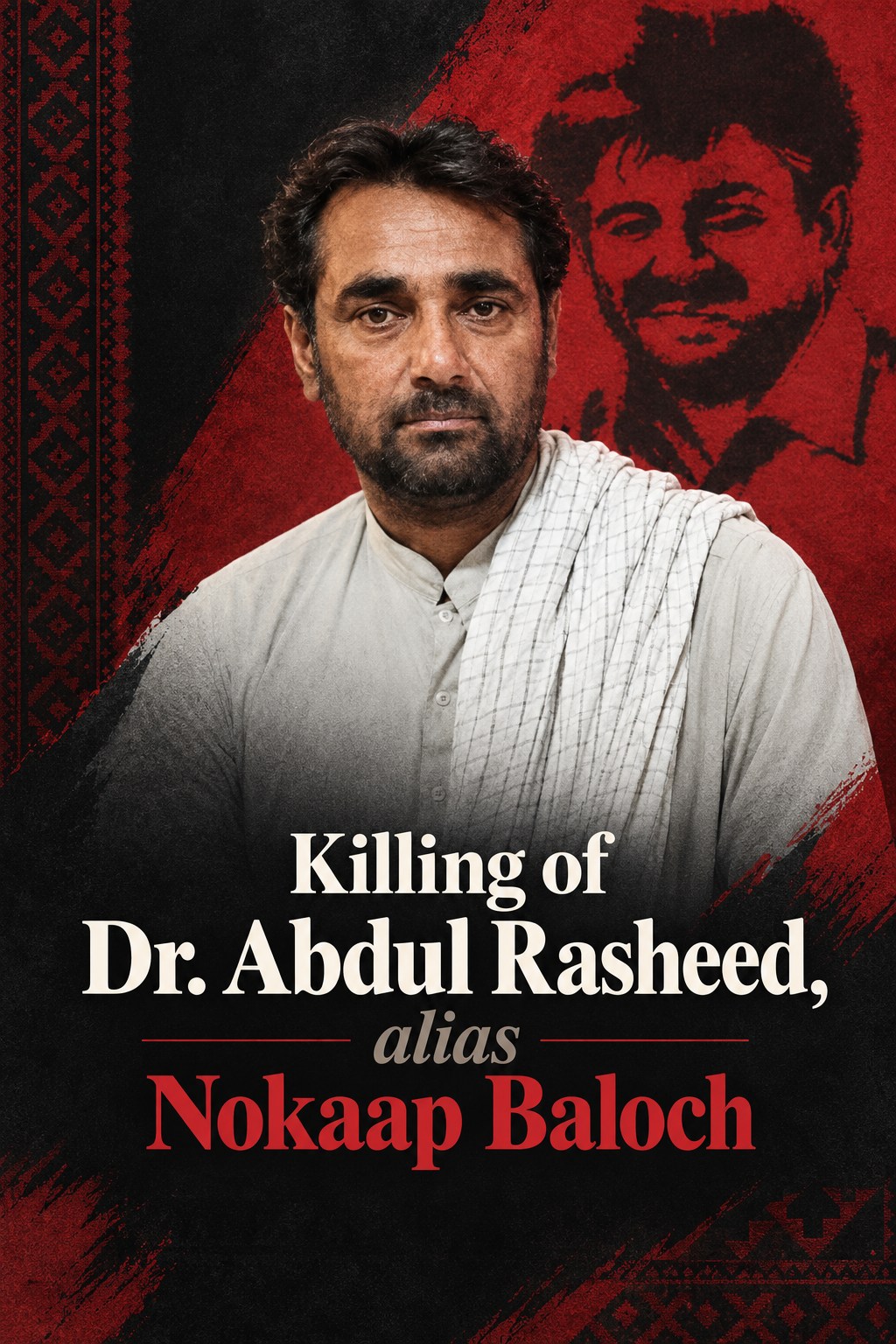
PAANK expresses grave concern over the targeted killing of Dr. Abdul Rasheed Baloch, also known as Nokaap Baloch, a doctor, educator, political activist, and member of the Central Committee of the Baloch National Movement (BNM).
According to information provided by Dr. Nokaap’s family and reported as verified by the PAANK team, Dr. Nokaap was killed on 11 September 2026, in the morning, at his residence in the Shamsar Hakabad area of Western Balochistan, in the Iranian-administered part of Balochistan.
According to an eyewitness, two armed men associated with a death squad arrived at Dr. Nokaap’s guest house while posing as patients. The eyewitness stated that the assailants subsequently opened fire on Dr. Nokaap, killing him. The individuals were linked to a death squad operating under the supervision of the Pakistani Army.
The circumstances of his killing raise serious human-rights concerns, particularly given his longstanding political activities, his previous experience of alleged reprisals, and his humanitarian work providing medical treatment and education to Baloch refugees and local communities.
Dr. Nokaap’s killing represents the loss of a dedicated doctor, educator, political activist, and community worker who devoted his life to serving vulnerable and displaced communities. Despite experiencing displacement and repeated threats to his own life, he remained committed to providing essential medical care, education, and humanitarian assistance to people in need, particularly those facing hardship and limited access to basic services.
Background
Dr. Abdul Rasheed Baloch, alias Nokaap Baloch, was born on 1982 in the home of Waja Ghulam Hussain in Gandachai, Kolowah, Awaran. From an early age, he pursued his education and developed a strong commitment to education and public service.
According to information available to PAANK, government schools existed in Gandachai and surrounding areas of Kolowah, but many faced a shortage of teachers. In response, Dr. Nokaap supported community efforts to arrange teachers and personally taught children on a voluntary basis for several years in the nearby village of Kenechi.
After completing his education, he continued to serve people in his community by providing free medical treatment. His work as a doctor and educator remained an important part of his life alongside his political and organisational activities.
Dr. Nokaap joined the Baloch National Movement (BNM) in 2010 and was among its early members in the Kolowah region. Beginning his organisational work at the grassroots level, he subsequently assumed several responsibilities within the organisation.
In 2010, he served as Vice President of the Gishkaur Zone, and in 2012, he became its President. Following the formation of new organisational zones that year, he was elected President of the Gandachai Zone.
In 2022, during the BNM Central Council session, Dr. Nokaap was elected as a member of the BNM Central Committee. He continued to carry out his organisational and political responsibilities until his death. Throughout his life, Dr. Nokaap combined his professional and political activities with a sustained commitment to serving people in underserved communities. His contributions to education and healthcare provided essential support to communities with limited access to these services.
Reprisals and Forced Displacement
According to information provided by Dr. Nokaap’s family, he had previously faced reprisals allegedly linked to his political activities and public role in Kolowah.
On 2016, his home was demolished during a military operation, and his property was looted by the Pakistani Army. The family also reported that attempts were made to kill him. As threats to his life and insecurity continued, Dr. Nokaap was ultimately forced to leave his home in 2018 and relocate to Western Balochistan.
Displacement did not end his commitment to his community. Despite being forced to leave his home, Dr. Nokaap continued his medical, educational, social, and political activities and remained engaged in supporting people in need.
The reported destruction of his home and subsequent displacement reflect broader concerns regarding the treatment of Baloch political activists and civilians who have been forced from their homes amid conflict, insecurity, and state repression.
Humanitarian Role
Dr. Nokaap’s contribution extended beyond his political activities. According to information provided by his family to PAANK, he devoted himself to providing medical and educational assistance to communities affected by displacement, insecurity, and deprivation amid reported Pakistani military operations.
After relocating to Western Balochistan, he worked among Baloch refugees and local residents in remote and underserved areas, where access to healthcare and education was limited.
He provided medical treatment free of charge to people who could not afford or otherwise access healthcare, offering care within the resources available to him. He also taught refugee and local children without charge, helping children continue their education despite displacement and difficult living conditions.
These efforts had a direct impact on communities with limited access to essential services. Through his medical work, Dr. Nokaap helped address immediate healthcare needs, while his teaching provided children with continued access to education. His sustained service enabled vulnerable and displaced families to access basic support that might otherwise have been unavailable to them.
Cross-Border Dimension
The killing of Dr. Nokaap raises concerns because it occurred outside Pakistan, in the Iranian-administered part of Balochistan.
According to information, the perpetrators were armed individuals linked to Pakistani state and military structures. The reported method of the attack, approaching Dr. Nokaap while posing as a patient and subsequently opening fire, suggests a targeted attack rather than an indiscriminate act of violence.
If substantiated through an independent investigation, the involvement of Pakistani state and military-linked actors in a killing carried out outside Pakistan would raise serious concerns regarding the possible cross-border targeting of Baloch political activists and refugees.
The incident therefore warrants examination not only as an individual killing but also in the broader context of concerns regarding the targeting of Baloch political activists beyond Pakistan’s territorial borders.
PAANK calls for the circumstances surrounding the killing to be independently documented and investigated, including the identities of those responsible, their affiliations, the chain of responsibility, the planning and execution of the attack, and any links between the perpetrators and Pakistani state, military, intelligence, or security institutions.
Human Rights Concerns
We have been documenting cases of enforced disappearance, extrajudicial killing, arbitrary detention, torture, and other serious human-rights violations affecting Baloch civilians and political activists.
The killing of Dr. Nokaap raises concerns regarding the right to life and the protection of individuals engaged in political activities, as well as medical professionals, educators, and displaced persons.
His case is particularly concerning in light of the reported history of threats against him, the destruction of his home, his subsequent forced displacement, and previous attempts on his life. PAANK emphasizes that medical professionals and educators providing essential services to vulnerable and displaced communities should be protected from threats, intimidation, and violence. The provision of medical care and education should not expose individuals to persecution or violence.