
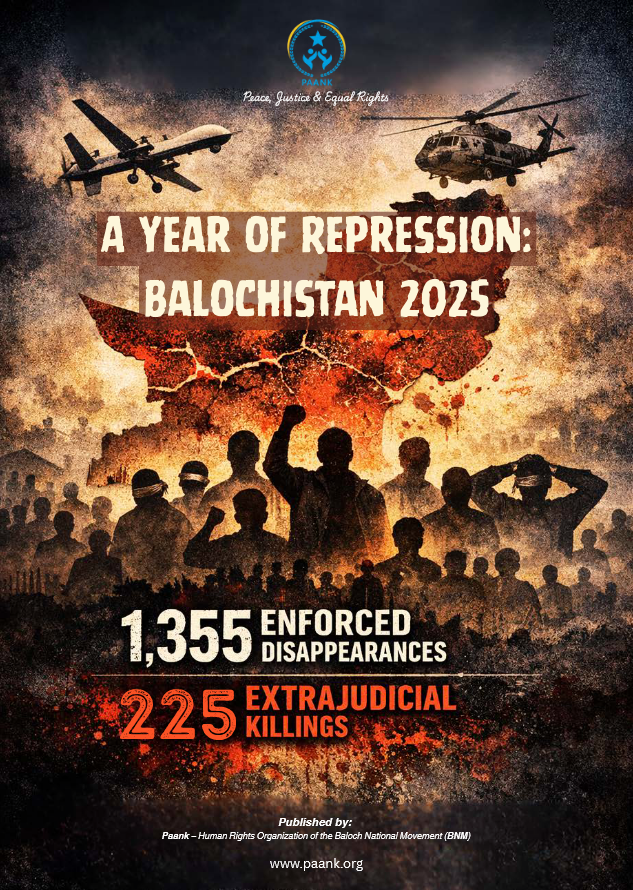
The human rights landscape in Balochistan throughout the 2025 reporting cycle reflects a profound and catastrophic erosion of the rule of law, characterized by a transition from conventional counter-insurgency operations to a comprehensive, multi-layered regime of state-sponsored repression.
Documented evidence gathered by Paank indicates that the state apparatus— primarily the Pakistani military, its multifaceted intelligence agencies, and the paramilitary Frontier Corps—has intensified its campaign against the Baloch population through a strategic combination of enforced disappearances, extrajudicial executions, and the novel deployment of sophisticated aerial warfare technology against civilian populations.
This report, prepared by the Human Rights Department of the Baloch National Movement (BNM), serves as an exhaustive record of these atrocities, synthesizing ground-level reporting with rigorous legal analysis to illustrate a systematic policy of collective punishment intended to neutralize the region’s intellectual, political, and social vanguard.
The 2025 calendar year was defined not only by the quantity of violations but by the qualitative shift in the methods of suppression. The normalization of drone strikes in civilian areas, the weaponization of anti-terrorism legislation to target peaceful civil rights movements like the Baloch Yakjehti Committee (BYC), and the persistent use of the “kill and dump” policy against students and activists suggest a state strategy that views the entire Baloch ethnic identity through the prism of security and existential threat. Despite the imposition of information blackouts and internet shutdowns, Paank has managed to verify and document 1,355 cases of enforced disappearance and 225 cases of extrajudicial killing, providing a harrowing statistical baseline for an ongoing humanitarian crisis.
Statistical Overview and Longitudinal Analysis of Violations
The data for 2025 reveals a sustained and high-intensity campaign of repression that remained consistent throughout the year, with specific surges in activity corresponding to periods of significant military operations. The following table provides a month-by- month aggregation of verified human rights violations, highlighting the unrelenting nature of the state’s security operations.
Period Enforced Disappearances Extrajudicial Killings Torture Survivors Released
January – June 785 121 261
July 96 19 40
August 98 11 32
September – October 195 43 12
November 95 20 21
December 86 11 41
Annual Total 1,355 225 407
The statistical evidence suggests that the first half of the year saw the most intensive wave of abductions, with 785 documented cases. This period coincided with heightened political activity and the state’s initial efforts to decapitate the leadership of grassroots movements. While the raw number of disappearances slightly decelerated in the final quarter, the lethality of state operations increased, as evidenced by the high ratio of extrajudicial killings to releases in the September– November period. The release of 407 torture survivors—often returned as physically and mentally broken individuals serves as a secondary mechanism of state terror, intended to broadcast the consequences of dissent to the broader community.
The Crisis of Enforced Disappearance: Mechanisms and Impacts
Enforced disappearance remains the primary instrument of state-sponsored terror in Balochistan. As defined under international law, these acts constitute a crime against humanity when committed as part of a widespread or systematic attack against a civilian population. In 2025, the documenting of 1,355 new cases highlights a policy that is both indiscriminate in its application to the Baloch population and highly specific in its targeting of the intelligentsia.
The Anatomy of an Abduction
The standard operating procedure for enforced disappearances in 2025 typically involved joint raids conducted by uniformed personnel of the Frontier Corps and plainclothes operatives from the Inter-Services Intelligence (ISI) or Military Intelligence (MI). These operations are characterized by a total absence of legal safeguards: there are no warrants, no identification of the detaining authority, and no information provided regarding the destination of the suspect. Victims are frequently subjected to public beatings, blindfolded, and forced into unmarked double-cabin vehicles.
Once abducted, individuals are held in a network of unacknowledged detention centers. One prominent site identified by survivors is the Kuli camp, a military facility in Quetta where detainees are reportedly subjected to systematic interrogation and physical abuse. The state’s refusal to acknowledge these detentions creates a legal “black hole,” denying the victims the right to habeas corpus and placing them entirely at the mercy of their captors. This practice is not merely an excess of security operations but a deliberate strategy to circumvent judicial oversight and international scrutiny.
The Generational Targeting of Students and Intellectuals
A distinguishing feature of the 2025 abductions was the disproportionate targeting of students and young professionals. Data from Paank and other human rights organizations indicates that a significant percentage of those disappeared were abducted from educational hostels, libraries, or while traveling to universities. This targeting of the “vanguard” of Baloch society suggests an attempt to destroy the intellectual capacity of the region to articulate its grievances or lead political movements.
The psychological impact of these abductions extends far beyond the individual. In Balochistan, where family structures are tight-knit and the “missing person” is often the primary or sole breadwinner, the economic and emotional devastation of a disappearance can paralyze an entire household for years. Families are left in a state of perpetual limbo, unable to mourn and unable to seek justice through a judiciary that remains largely deferential to the military establishment.
Extrajudicial Execution and the “Kill and Dump” Policy
The discovery of 225 bodies of previously disappeared persons in 2025 confirms the ongoing and brutal reality of the “kill and dump” policy. This strategy involves the execution of detainees in custody, followed by the abandonment of their mutilated remains in desolate areas, often accompanied by labels designating them as “terrorists” or “insurgents” to retroactively justify their deaths.
Analysis of Key Incidents
Several cases from 2025 illustrate the horrific details of this policy and the impunity with which it is carried out:
Zeeshan Zaheer: A prominent student activist and BYC member, Zeeshan was abducted on June 29. His body was found the following day, showing clear evidence of severe torture. His case is particularly emblematic as his father had also been “disappeared” in 2015, highlighting the intergenerational trauma inflicted by the state.
Usman Maqbol: Forcibly disappeared from Turbat on August 24, his body was recovered just two days later. The speed with which he was executed after his abduction suggests a shift toward immediate elimination rather than prolonged interrogation for certain high-profile activists.
Khalil Ahmed: A serving police employee, Khalil was abducted by intelligence agencies on December 13. Within hours, his tortured and bullet-riddled body was recovered. The fact that a government employee could be so brazenly disappeared and killed by his own state’s security apparatus underscores the total breakdown of institutional safeguards.
Kareem Jan: A survivor of a previous disappearance in 2023, Jan was abducted again on February 25, 2025, and extrajudicially killed while in custody. His death while in state custody led to widespread calls for an independent UN investigation into what many term a “slow-motion genocide”.
The Role of State-Backed Militias
Criminal syndicates that are armed and protected by the military to act as proxies. These groups provide the state with a layer of deniability, allowing it
to frame the violence as “internal tribal feuds” or “clashes between militant factions.” However, the logistical support and immunity these groups enjoy reveal them to be integral components of the official security architecture.
Notorious death squad leader Shafiq Mengal (center), flanked by the current Chief Minister of Balochistan, Sarfaraz Bugti (left), who allegedly oversees a death squad in Dera Bugti, and former caretaker Prime Minister of Pakistan, Anwaar-ul-Haq Kakar (right).
Aerial Warfare: The New Frontier of State Terror
The most alarming development of 2025 was the state’s expanded use of aerial warfare—including drone strikes and helicopter gunships—against civilian residential and recreational areas. These operations are typically conducted under the guise of “intelligence-based operations” (IBOs) but have repeatedly resulted in civilian massacres.
The Zehri Aerial Bombardment (September 17)
On September 17, 2025, military helicopters conducted an aerial bombardment on civilian homes in the Zehri area of Khuzdar district. The strike resulted in the deaths of three civilians, including two women: 40-year-old Bibi Amina and 41- year-old Lal Bibi. A 4-year-old child was also among the injured. The subsequent blockade of the area and a months-long internet shutdown prevented the full scale of the tragedy from being reported immediately, demonstrating the state’s use of information control as a strategic military tool.
The Buleda Drone Strike (October 29)
In one of the year’s most egregious incidents, a drone strike in the Buleda area targeted a group of four young men—Zakir, Razzaq, Sadiq, and Peer Jan— while they were on a picnic. Crucially, the group had obtained prior military permission for their outing, which is mandatory in highly militarized zones of Balochistan. Despite this, they were targeted and killed. Following the strike, the Inter-Services Public Relations (ISPR) and state media falsely labeled the victims as “high-level terrorists”. This incident highlights the inherent dangers of “signature strikes,” where behavioral patterns (such as a group of men in a specific area) are used as a proxy for militant identification, often with fatal results for innocent civilians.
The Chiltan Hills Attack (October 28)
Near Quetta, on October 28, an aerial strike targeted nine young men who were also on a picnic. The strike caused catastrophic injuries to several teenagers. Reports indicate that once the authorities realized the victims were civilians, they moved aggressively to suppress the information and prevent families from speaking to the media. These attacks violate the most fundamental principles of International Humanitarian Law (IHL), including the principles of distinction and proportionality.
Legal Weaponization and the Suppression of the BYC
A defining feature of the 2025 crackdown was the state’s aggressive campaign to criminalize the Baloch Yakjehti Committee (BYC). The BYC, a peaceful civil rights movement led primarily by women, emerged as a powerful voice against enforced disappearances, making it a primary target for legal and physical repression.
Abuse of the Maintenance of Public Order (3MPO)
The state systematically utilized Section 3 of the Maintenance of Public Order Ordinance (MPO) to bypass the judicial system. The 3MPO allows the district administration to detain individuals for up to 90 days without an FIR or formal charge, based on the mere suspicion that their activities might be “prejudicial to public safety”. In 2025, this law was used to arbitrarily detain high-profile leaders such as Dr. Mahrang Baloch, Beebarg Baloch, and Sibghat Ullah.
These detentions are part of a broader “weaponization of the law,” where anti-terrorism statutes are used to silence political dissent. Many activists remained in custody well beyond the 90-day limit permitted by the MPO, a clear violation of Pakistan’s own constitutional guarantees of liberty and fair trial (Articles 10 and 10A).
The Fourth Schedule: Civil Death for Activists
The state escalated the inclusion of peaceful activists in the “Fourth Schedule” of the Anti-Terrorism Act (ATA). Being placed on this list effectively results in a “civil death,” as it imposes severe restrictions on an individual’s life without a criminal conviction. In October 2025, at least 32 individuals, including prominent women activists like Sammi Deen Baloch and Dr. Sabiha Baloch, were added to this list.
The restrictions under the Fourth Schedule include:
Mandatory and frequent reporting to local police stations.
Prohibition of travel outside of a designated area without express police permission.
The freezing of all bank accounts and financial assets belonging to the individual or their family.
Continuous surveillance and harassment by intelligence agencies.
The UN has noted that the vague and overbroad definition of “terrorism” in the ATA allows for these abusive listings, which strip individuals of their rights to privacy, movement, and freedom of expression.
Torture and the Treatment of Detainees
The release of 407 torture survivors in 2025 provides a window into the systematic abuse occurring in state custody. Torture is not incidental in the Balochistan conflict; it is a central tool for extracting forced confessions and breaking the will of political activists.
Systematic Abuse in Custody
Survivors consistently describe a regime of psychological and physical brutality. Common methods of torture documented by Paank and other observers
include:
- Physical Violence: Severe beatings with leather belts, sticks, and iron rods; the use of electric shocks; and the pulling of fingernails.
- Positional Torture: Hanging detainees upside down for hours or forcing them to remain in stress positions for days.
- Deprivation: Prolonged sleep, food, and water deprivation; keeping detainees in “white rooms” with continuous bright lights to induce sensory overload and psychological breakdown.
- Sexual Abuse: Reports of sexual violence and humiliation against both male and female detainees.
The impact of this torture is often permanent. Many survivors are released as “living corpses”—mentally paralyzed individuals who are unable to reintegrate into society or continue their education. This form of “psychological warfare” is intended to serve as a visual deterrent to other youth in Balochistan, signaling that the price of political participation is the destruction of one’s self.
Economic Marginalization and Resource Extraction
The human rights crisis in Balochistan is inextricably linked to the state’s economic policies, which prioritize the extraction of natural resources over the well-being of the local population. Large-scale projects like the China-Pakistan Economic Corridor (CPEC), the Reko Diq mine, and the Saindak project have become focal points for both state repression and local resistance.
The Paradox of Resource Wealth
Balochistan is current Pakistan’s most resource-rich province, yet its population remains the most impoverished. The provincial government and local elites are often bypassed in decision-making, with the military establishment exerting control over the management and security of mining and infrastructure projects.
- Reko Diq: Estimated to hold copper and gold reserves worth over $60 billion, the project is managed by international firms and the federal government, with minimal benefits reaching the local Baloch communities.
- Gwadar Port: Billed as the crown jewel of CPEC, the development of Gwadar has led to the displacement of local fishermen and the imposition of severe security restrictions that stifle the local economy.
The state views any demand for resource sovereignty or fair compensation as an act of “terrorism” or “foreign-funded subversion.” Consequently, activists who advocate for economic rights are frequently disappeared or labeled as enemies of development.
Throughout 2025, Pakistan’s human rights record in Balochistan came under increasing international scrutiny, particularly concerning its trade relations with the European Union. Pakistan is a major beneficiary of the EU’s Generalized Scheme of Preferences Plus (GSP+), which provides tariff-free access to European markets in exchange for the effective implementation of 27 international conventions on human rights, labor rights, and governance.
The GSP+ Monitoring Mission (2025)
An EU monitoring mission visited Pakistan in late 2025 to assess compliance. The mission highlighted several areas of “grave concern” that align with Paank’s findings:
- 1) Enforced Disappearances: The mission noted the lack of progress in criminalizing enforced disappearance and the failure to hold security forces accountable.
- 2) Freedom of Expression: The use of the Prevention of Electronic Crimes Act (PECA) and internet shutdowns in Balochistan were cited as significant violations of the right to information.
- 3) The Anti-Terrorism Act: The EU echoed UN concerns that the ATA is being used to target human rights defenders rather than actual terrorists.
Critics and human rights defenders have argued that the EU’s continued granting of GSP+ status to Pakistan—despite its consistent failure to meet human rights commitments—undermines the credibility of the EU’s values- based trade policy. Renewing the status in the face of “slow-motion genocide” in Balochistan is seen by many as underwriting a rogue state apparatus.
Conclusion: A Policy of Collective Punishment
The evidence compiled in this report demonstrates that the human rights violations in Balochistan during 2025 were not accidental or the result of “rogue elements” within the security forces. Instead, they represent a deliberate and systematic state policy of collective punishment. By targeting the youth, the intellectual elite, and peaceful civil movements, the state seeks to destroy the social and political fabric of Baloch society and maintain control over its resources through fear and violence.
The normalization of aerial warfare, the expansion of the “kill and dump” policy, and the weaponization of anti-terrorism laws signify a transition to a more lethal phase of the conflict. This phase is characterized by a total disregard for international humanitarian law and a reliance on technological superiority to suppress local grievances.
Strategic Recommendations for Immediate Action
In light of the documented atrocities and the deteriorating humanitarian situation, Paank – Human Rights Department of the BNM, issues the following urgent recommendations:
To the Government of Pakistan
- End Enforced Disappearances: Immediately halt the practice of enforced disappearances and ensure the safe return of all 1,355 individuals abducted in 2025 and thousands of others missing from previous years.
- Abolish the “Kill and Dump” Policy: Conduct transparent, independent investigations into the 225 extrajudicial killings documented in 2025 and prosecute the military and intelligence personnel responsible.
- Cease Aerial Warfare Against Civilians: Immediately stop the use of drones and helicopter gunships in civilian areas and provide full compensation to the families of victims in Buleda, Zehri, and the Chiltan Hills.
- Repeal Repressive Laws: Rescind the 3MPO and amend the Anti-Terrorism Act and the Fourth Schedule to bring them in line with international human rights standards.
- Release Political Prisoners: Immediately release Dr. Mahrang Baloch and all other BYC activists and drop all fabricated charges against them.
- End Internet Blackouts: Restore full and unrestricted internet and mobile connectivity to Balochistan to allow for the reporting of human rights abuses and the exercise of the right to information.
To the United Nations and International Human Rights Bodies
- Mandate a Fact-Finding Mission: The UN Human Rights Council should immediately establish an independent, international fact-finding mission to investigate war crimes and crimes against humanity in Balochistan.
- Appoint a Special Rapporteur: The UN should appoint a specific special rapporteur to monitor the situation in Balochistan and report on the “kill and dump” policy and the use of drones against civilians.
- Pressure for Ratification: International bodies must pressure Pakistan to ratify the International Convention for the Protection of All Persons from Enforced Disappearance.
To the European Union and GSP+ Partners
Condition Trade on Human Rights: The European Commission should suspend Pakistan’s GSP+ status until the government can demonstrate a verifiable end to enforced disappearances and the prosecution of those responsible for extrajudicial killings.
Targeted Sanctions: Implement Magnitsky-style sanctions against high-ranking military and ISI officials who are directly linked to human rights atrocities in Balochistan.
The failure of the international community to act in the face of this evidence is not only a betrayal of the Baloch people but a significant threat to the global human rights architecture. The pattern of state behavior in Balochistan—if left unchecked—will continue to serve as a blueprint for authoritarian regimes worldwide on how to use technology and the law to eliminate dissent with total impunity.
About Us
Paank is the human rights department of the Baloch National Movement (BNM), which aims to raise awareness and promote human rights in Balochistan. BNM is a political organization dedicated to the rights and freedoms of the Baloch people in Balochistan.
Paank focuses on the protection and promotion of human rights in Balochistan by conducting investigations, documenting human rights abuses, and advocating for change. Its monthly report on the human rights situation in Balochistan provides up- to-date information on the state of human rights in the region and highlights areas where improvement is needed. These reports serve as a valuable resource for those concerned with human rights in Balochistan and provide a platform for BNM to voice its concerns and advocate for change.
One of the key areas of focus for Paank is the issue of enforced disappearances in Balochistan. This is a serious concern in the region and has been widely reported by human rights organizations. Paank works to document cases of enforced disappearances and bring attention to this issue in the hopes of bringing an end to this human rights violation.
The website will regularly update information on enforced disappearances, including the number of cases, the names of those who have disappeared, and the efforts being made to secure their release. Paank is also active in organizing events and activities that promote human rights in Balochistan. These events range from peaceful protests to public awareness campaigns and educational seminars.
Paank’s events provide a platform for the Baloch people to voice their concerns and demand change. The website will share updates on Paank’s
events and activities, allowing supporters to stay informed and get involved. Paank is a vital part of BNM’s efforts to promote human rights in Balochistan. Its monthly reports and updates on enforced disappearances provide valuable information and insight into the human rights situation in the region. Its events and activities help to raise awareness and promote change. The website provides a platform for Paank to share its work and engage with supporters, making it an essential resource for anyone concerned with human rights in Balochistan.
Baloch National Movement (BNM) is an organization struggling for the independence of Balochistan from Pakistan. The human rights department of BNM, known as Paank, focuses on raising awareness about the human rights situation in Balochistan. Paank’s mission is to advocate on all forums to bring global attention to the atrocities committed in Balochistan and to work towards a better future for the Baloch people.
Paank’s team is dedicated to creating a brighter future for the Baloch people. Through their tireless efforts, Paank works to bring justice to the victims of human rights violations in Balochistan and to hold those responsible accountable for their actions.